
Understand the prize before you play
See how wagers contribute to a changing jackpot and why game rules, eligibility and long-shot odds matter.

How the Jackpot Pool Builds Between Spins
A progressive prize does not stay fixed while a game is being played. A portion of eligible wagers is added to a pool, so its displayed value can rise from spin to spin until a winning result is recorded. That accumulating amount is what makes a progressive jackpot different from a fixed prize: its value changes as play contributes to it.
The basic sequence is straightforward. A player makes a wager, the game allocates a predetermined share to the jackpot pool, and the remaining play proceeds under the game’s rules. The contribution may be small beside the full wager, but repeated contributions add up. If no qualifying win occurs, the pool continues to grow. When the jackpot is won, the accumulated prize is paid and the pool returns to a base amount, then begins building again.
There is not one universal contribution rate. Descriptions of the mechanic give different ranges: one account puts the typical share at 1% to 3% of a wager, while another gives 1% to 5%. That difference should not be smoothed into a single promise. The rate depends on the game’s design, so the clearest figure for a particular pokie is the one shown in its paytable or help screen. A general description of progressive jackpot pokies can explain the process, but it cannot tell you the exact allocation for every title.
Top operators
Choosing progressive jackpot slots is about more than the games themselves: you should also check the operator details before deciding where to play. Use these concise operator notes as a starting point for your own checks.
-
Thor Casino
- License
- Curacao – Antillephone N.V. (Versus Odds B.V.)
- Min. deposit
- EUR 20
Thor Casino lists a Curacao licence from Antillephone N.V. (Versus Odds B.V.) and a minimum deposit of EUR 20. Check the available jackpot games and terms before you play.
-
Lucky Dreams
- License
- Curacao
- Min. deposit
- A$20 (POLi)
Lucky Dreams lists a Curacao licence and a minimum deposit of A$20 via POLi. Check whether its current game selection includes the progressive jackpot slots you want.
-
DragonSlots Casino
- License
- Curacao Gaming Authority (Jumpman Gaming Ltd)
DragonSlots Casino lists a Curacao Gaming Authority licence held by Jumpman Gaming Ltd. The available details are limited, so check its game selection and terms for yourself.
-
Neospin
- License
- Curacao Gaming Control Board OGL/2023/176/0095 (Hollycorn N.V.)
Neospin lists a Curacao Gaming Control Board licence, OGL/2023/176/0095, held by Hollycorn N.V. Check the current catalogue and terms to see whether it suits your jackpot-slot preferences.
-
Playfina Casino
- License
- Curacao eGaming (Hollycorn N.V., since 2017)
- Min. deposit
- A$20-30 (depends on the offer)
Playfina Casino lists a Curacao eGaming licence held by Hollycorn N.V. since 2017, and a minimum deposit of A$20–30 depending on the offer. Review the applicable offer conditions and game selection before playing.
-
7Bit Casino
- License
- Curacao, operated by Dama N.V.
7Bit Casino lists a Curacao licence and is operated by Dama N.V. Check its current selection and terms to confirm the progressive jackpot options available to you.
-
House of Pokies
- License
- international iGaming licence – jurisdiction not named in the source
- Payout speed
- PayID 1-24 hours
- Min. deposit
- A$30 (PayID from A$10)
House of Pokies lists an international iGaming licence, though the source does not name the jurisdiction. It lists PayID payouts of 1–24 hours and a minimum deposit of A$30, or A$10 via PayID.
-
JustCasino
- License
- Curacao Gaming Control Board
JustCasino lists a Curacao Gaming Control Board licence. Check its current game catalogue and terms to assess its progressive jackpot offering.
-
SpinsUp
- License
- Curacao Gaming Control Board OGL/2023/174/0082 (Dama N.V.)
SpinsUp lists a Curacao Gaming Control Board licence, OGL/2023/174/0082, held by Dama N.V. Check the current catalogue and terms for details relevant to your jackpot-slot choices.
-
Golden Pokies
- License
- Curacao
Golden Pokies lists a Curacao licence. The available details are limited, so check its game selection and terms before deciding whether it fits your needs.
It also helps to separate the pool from the display. The counter shown on screen is a presentation of the jackpot value, not a second prize being created by the player’s latest spin. A small change after a wager reflects another contribution entering the pool. A larger value may reflect many previous contributions. The displayed figure therefore represents an amount that has accumulated over time, rather than a forecast of what the next spin will do.
What “shared” means in the pool
A progressive pool can be described as shared because contributions accumulate in one prize rather than forming a separate growing award for every spin. That wording does not, by itself, tell you which games contribute, how broadly the pool is connected, or who holds it. Those details depend on the game arrangement and are separate from the simple contribution-and-reset cycle.
For a player, the useful distinction is between the wager and the jackpot allocation. The wager is the amount put into the spin; the allocation is the portion directed to the progressive prize. The contribution does not sit in a personal account for the player, and it does not make a future win due. It becomes part of a pool that can be awarded when the game registers the winning result. No timing pattern changes that process.

A rising counter can draw attention because it makes the prize visible and gives each contribution a clear destination. But a larger number on screen is still only the current pool value. It does not show how close a winning result is, nor does it mean that a particular player’s past contributions have improved their position. The pool grows through turnover; the win depends on the game’s outcome.
The reset is part of the cycle
After a jackpot is hit, the pool is not left at its previous total. It is reset to a base value and accumulation begins anew. The base amount gives the next cycle a starting point; subsequent eligible wagers add to it again. In that sense, a progressive jackpot has two phases: a building phase while contributions arrive, and a reset followed by another building phase after a win.
This reset can make the displayed value look dramatically different before and after a jackpot, but it does not change the underlying principle. Each cycle follows the same broad pattern: contributions raise the pool, a qualifying result awards it, and a new pool starts from its base. The exact way a game recognises a qualifying result is a separate feature of its rules.
Do
- Check the game's help screen for the stated contribution rate
- Refer to the paytable for the most accurate figures
- Use a clearly explained mechanism to inform your choice
Don't
- Assume another game's rate applies to the current title
- Rely solely on an impressive jackpot counter
- Smooth different contribution ranges into a single promise
When comparing online progressive slots, the contribution rate and reset behaviour are more useful criteria than the largest number currently on a screen. Check the game’s help information for the stated contribution and how the pool is described. If the rate is not clearly shown, do not assume that another game’s rate applies. The better choice depends on what you want to understand: a clearly explained contribution mechanism is more informative than an impressive counter alone.
Keep the pool in perspective when deciding what to spend. Set a strict weekly deposit limit and stick to it regardless of the displayed jackpot; never use rent money, and do not chase losses or raise stakes to try to catch a growing prize. A progressive pool can continue to rise without offering any signal that a win is near. That is the mechanism, not a schedule.
What an Online Casino Changes—and What It Doesn’t
An online progressive jackpot can look as though it belongs to the casino whose website displays it. That is not necessarily how the underlying arrangement works. The jackpot pool is held on the software provider’s server, not at an individual casino. The casino may present the game, but the pool’s location is a separate question from where you see the reels.
Think of the game and the casino as different layers. The provider supplies the game software and maintains the jackpot pool on its server. A casino website is the setting in which the game may be displayed to a player. Those roles can sit together on one screen, but they are not interchangeable. A jackpot shown on a casino page is not, for that reason alone, a pool held by that casino.

That distinction matters when you compare progressive jackpot casino slots. A familiar logo, game lobby or jackpot display can make the casino seem like the source of the prize. The display is evidence of what the site presents, not proof that the casino owns or stores the pool. For the pool’s location, the relevant distinction is provider server versus individual casino.
The provider’s pool and the casino’s display
The provider-server arrangement gives the jackpot a connection to the game software rather than to a particular casino’s own jackpot pot. A casino may offer access to a game, while the pool itself remains with the provider. So, when you encounter an online casino progressive jackpot, separate two questions: who supplies the game and where is its jackpot pool held? The answer to the second is the provider’s server, not the individual casino.
This is a useful correction to the impression created by a single interface. A page may place the game, jackpot amount and casino branding close together. Visually, that is tidy. Structurally, it can blur the difference between the website presenting a game and the provider holding its pool. The screen does not turn those separate roles into one.
It also means the casino name alone cannot tell you how the pool is arranged. Two websites displaying a game do not thereby become the owners of separate versions of its pool. Nor does a casino’s display establish that it can independently change the provider-held pool. The safe reading is narrower: the casino presents the game, while the jackpot pool is held on the software provider’s server.
What the casino can and cannot tell you
A casino’s game page can help you identify what it is presenting, but it should not be treated as a complete explanation of the jackpot’s technical arrangement. The provider is the relevant party for the game software and server-held pool. A casino’s branding around the game does not change that fact.
That separation is also why “progressive jackpot online casino” is not a single technical category. The phrase can describe a casino site showing a progressive game, but it does not tell you whether the pool is casino-specific or provider-held. In this case, the pool is held by the software provider rather than by one casino. The casino is where the game is displayed; it is not where that pool is stored.
For you, the practical point is about attribution, not a promise about access or a judgment of any operator. Do not assume that the casino named on the page created the jackpot, holds it on its own systems, or controls every part of its operation. Those conclusions do not follow from the display. The provider-server detail is the firmer distinction.
Australia’s legal setting
There is an important local limit to this discussion. Under Australia’s Interactive Gambling Act 2001, operators cannot provide real-money online casino games, including slots, to people physically located in Australia. That prohibition concerns the service offered to Australian customers; it does not change where a provider’s jackpot pool is stored. A provider-held pool and the legal status of an online casino service are separate issues.
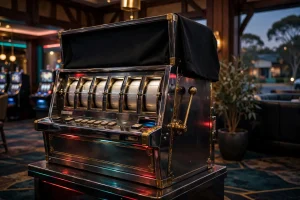
Accordingly, describing how an online jackpot is structured should not be read as recommending that you use an offshore site. Nor does a provider’s server location make a prohibited service permissible for Australian customers. The technical relationship between a provider and a casino does not override the law applying to people in Australia.
The distinction is simple, even if a game page makes it look otherwise: the casino may display the game, but the progressive pool is held on the software provider’s server. A screen can join the branding. It cannot move the pool.
Slot Machines, Game Cost and the Limits of RTP
A progressive feature changes the economics of a pokie, not just the size of its headline prize. Part of each wager is assigned to the jackpot rather than the base game. That leaves a smaller share of the stake available for ordinary reel wins, so the base game’s house edge is slightly higher than that of a comparable non-progressive version.
This distinction matters when you compare progressive jackpot games. The displayed prize is only one part of the game’s cost and potential return. A large pool can look compelling, but it does not tell you how much the base game returns through its regular features. Nor does it make the game a better choice for every player. If your criterion is more frequent or stronger base-game returns, the jackpot figure alone cannot settle the comparison.
What RTP tells you
Return to player, or RTP, is commonly used to describe a game’s theoretical payout as a share of the money wagered over a long period of play. In Australia and the UK, information about game cost often includes an RTP figure or another expression of average payout. It can be useful for comparing games when the figures refer to the same kind of return and the same version of a game.
But RTP is not a session forecast. It does not say what you will get back from a particular sequence of spins, and it does not promise that your personal results will approach the stated rate. A game can return less than its RTP suggests during your play, or more; the figure describes long-run behaviour, not a result you can schedule.
That distinction has legal significance as well as practical importance. In 2018, the Australian Federal Court found information about RTP misleading because it could be understood as describing short-term winnings, when it represents long-term outcomes. Treat the figure as a broad game comparison measure, not a cash-out estimate.
Compare like with like
When you assess progressive jackpot slot machines, separate the base-game return from the jackpot element wherever the game information allows. Two games may both display an RTP, yet the displayed figure may not tell you how much of the return comes from the ordinary game and how much is associated with the progressive prize. Check the game’s information and paytable rather than assuming that a headline RTP gives a complete picture of the jackpot’s contribution.

The useful comparison is therefore not simply “higher RTP wins.” Ask what the figure represents, whether it includes the progressive feature, and whether you are comparing the same type of game. If those details are unclear, the figure cannot support a precise ranking. Best depends on your criterion: a player focused on the jackpot may weigh the feature differently from someone comparing base-game returns.
The house edge and RTP are related ways of describing game economics, but neither predicts the next spin. A theoretical return is not a personal entitlement, and a small difference in a published figure does not guarantee a noticeable difference in one session. The arithmetic has a long horizon.
For your own comparison, read the paytable and help screen for the game’s stated return information, contribution details, volatility and any jackpot cap. These describe different parts of the experience; one figure cannot stand in for all of them. Keep your stake within a strict weekly deposit limit, and do not use rent money or chase losses in pursuit of a better result. A progressive jackpot casino game still charges for play through its underlying economics, whether or not the prize pool looks unusually attractive.
RTP is a comparison tool, not a promise. The distinction is the point.
Check the Bet Rules Before You Qualify
A jackpot label does not tell you whether every wager is eligible. In one progressive pokie, a minimum-bet spin may qualify; in another, you may need to stake the maximum. Some games permit any bet size for jackpot eligibility, while others make the top stake a condition. The title’s rules—not the word “progressive”—decide which applies.
- Open the game's help screen and paytable
- Locate the direct statement about jackpot qualification
- Determine if eligibility depends on a specific bet size
- Confirm if the maximum stake is a mandatory condition
That difference matters before you choose a stake. If you assume a small bet qualifies and the game requires the maximum, you could play without being eligible for the prize. If you assume the maximum is compulsory when any bet will do, you might risk more than the rules require. Neither assumption is a substitute for checking.
Find the eligibility rule first
Open the game’s help screen and paytable before staking money. Look for a direct statement about jackpot qualification, including whether eligibility depends on the bet size or a particular stake level. If the wording is unclear, do not treat an ambiguous rule as permission to assume you qualify.
A maximum-bet condition should be treated as a firm cost of entry, not a suggestion to increase your wager gradually. If that stake is outside your budget, the practical choice is not to chase it. A jackpot is not worth stretching your spending limit, and playing with rent money is strongly discouraged.
Also check whether the game distinguishes between ordinary play and jackpot-eligible play. A display showing a progressive prize does not, by itself, confirm that the current wager qualifies. Use the game’s own paytable or help information to confirm the rule for that title.
Any bet does not mean equal eligibility
Where a game allows any bet size, that answers one specific question: whether the stake can qualify. It does not establish that every stake has identical jackpot eligibility. A specialist affiliate review reports that, on some network progressives, the chance of a hit can scale with the wager, with maximum-bet spins receiving greater eligibility than minimum-bet spins. That is a claim about certain games, not a rule that can safely be applied to every progressive.

The distinction is useful: “eligible at any bet” and “identical chance at any bet” are not interchangeable statements. Check the title’s rules rather than extending a claim about one kind of game to another. If the help screen does not explain how wager size affects eligibility, do not fill the gap with an assumption.
Set a stake you can sustain
Compare the required stake with your own budget, not with the size of the displayed jackpot. A maximum-bet requirement can make a game unsuitable for you even if the game otherwise allows jackpot play. Do not raise stakes simply to satisfy a condition when you cannot afford that level, and do not chase losses by moving to a higher bet.
Set a strict weekly deposit limit before any gambling and stick to it whatever the jackpot display shows. If a game’s only eligible stake exceeds what you have set aside, leave it. The pool’s size does not change your personal limit.
For a clear comparison, record each game’s qualification rule, the minimum stake available, and whether the maximum is required. “Any bet qualifies” and “maximum bet required” are meaningfully different categories; the better fit depends on your budget and the game’s written terms. A tidy comparison beats a guess.
These checks are practical information, not an invitation to play. Under Australia’s Interactive Gambling Act, operators cannot provide real-money online casino games, including pokies, to people in Australia. If you are reviewing game rules, keep that legal restriction in view rather than treating an eligibility condition as a reason to seek access.
A Larger Jackpot Is Still a Long Shot
A rising prize can make a progressive jackpot look more attainable than it is. The number on the display tells you how large the possible payout has become; it does not tell you that a win is near. The jackpot can keep growing while each eligible spin remains an uncertain event.
For top-tier prizes, the odds are typically somewhere between one in 30 million and one in 100 million. Put another way, the chance is well below 0.001%. That scale matters more than the headline figure when you are judging whether a progressive jackpot slot game is a sensible use of your money. A large prize is attention-grabbing; the probability is less obliging.
A bigger pool does marginally lift the expected return on bets that qualify for the jackpot. That is a mathematical effect, not a forecast. It cannot show when a prize will land, and it does not turn a long shot into a likely result. Past spins, a quiet game, or a pool that has climbed for a long time cannot tell you that the next spin is due.

Large does not mean imminent.
This is also why “largest progressive slot jackpot” is not a useful stand-alone way to compare games. The prize size is only one criterion. If you care about the chance of a top-tier win, the scale of that chance matters; if you are considering the possible payout, the size matters. Neither changes the randomness of the result. No timing pattern or betting strategy guarantees a jackpot.
Keep the possible prize separate from your spending decision. Set a strict weekly deposit limit and stick to it, whatever the displayed jackpot. Bet only within your budget, and do not chase losses or increase your stakes because the pool has grown. Playing with rent money is strongly discouraged. A large jackpot is not a reason to risk money needed for essentials.
Before playing, check the terms for how a major win would be paid. Some very large prizes may be paid in instalments or face low monthly withdrawal caps. Verify the payout terms, withdrawal limits and payment methods for large transfers in advance; a headline prize does not, by itself, explain how or when you would receive it.
There is also an important Australian context: providing real-money online casino-style games to people in Australia is prohibited under the Interactive Gambling Act 2001. The odds and payout considerations do not change that legal position. A theoretical prize is not a reliable income plan, and it should never be treated as one.
Free Spins, Bonuses and the Cost of Claiming
Free play can show you a progressive pokie’s features without putting real money at stake, but it is not the same as playing for a cash prize. A demo balance or promotional spin does not make a jackpot win withdrawable. Before treating any promotion as valuable, check whether it is free play only, whether winnings can be converted to cash, and what conditions apply.
For people in Australia, there is an important legal distinction: the Interactive Gambling Act 2001 prohibits operators from providing real-money online casino games, including slots, to customers physically located in Australia. A free-play mode is not a route around that restriction for real-money play.
Read the wagering terms first
A bonus may require you to wager before its winnings can be withdrawn. Check what amount the requirement applies to, which games count, whether a maximum bet applies while wagering, and when the promotion expires. Do this before claiming, not after the balance has become conditional.
Progressive jackpot winnings are commonly excluded from contributions toward bonus wagering requirements. That can leave you with a large-looking balance that does little to meet the conditions for cashout. Free-spin winnings may also be subject to wagering rules, making them difficult to withdraw once those rules are applied. The headline offer is only one line in the comparison; the terms decide the rest.
A specialist review has reported jackpot boosts with wagering requirements of 30x or more, but that is a report about particular offers, not a universal condition. The multiplier matters alongside the bonus value: a specialist review’s comparison notes that a high-value bonus with a 50x requirement can cost more to clear than a modest bonus with a 10x requirement. Bigger is not automatically better.

For a fair comparison, put the bonus value, wagering basis, eligible games, exclusions and withdrawal conditions side by side. If the conditions make the cashout unlikely or require spending beyond your budget, declining the offer is the clearer choice. Set a strict weekly deposit limit and stick to it; never use rent money or chase losses to satisfy a promotion. No bonus makes a jackpot predictable or turns gambling into reliable income.
How a Progressive Jackpot Can Be Triggered
A progressive jackpot can be activated in several ways, and the distinction matters: a visible reel combination is not the same mechanism as a hidden threshold. The game’s paytable or help screen is the place to check how its jackpot trigger is defined; do not assume that one pokie’s rules apply to another.
Symbol-driven triggers
In a symbol-driven game, a specified combination on the reels awards the jackpot. The chance of triggering it is the chance of landing that particular combination on the reel strips. The symbols provide a visible condition, but they do not make the result controllable: each spin remains random, and past spins or apparent patterns do not tell you when the combination will appear.
Mystery or deterministic triggers
A mystery jackpot does not depend on landing a named combination. It begins at a set value, increases as bets are made, and is awarded when it passes a concealed threshold. The threshold is hidden, so the current prize value does not reveal how close the game is to awarding it. Once triggered, the mystery pool resets.
Symbol-driven
Awarded when a specified combination lands on the reels; the condition is visible but the result is random.
Mystery
Awarded when a pool passes a concealed threshold; both the activating point and the outcome are hidden.
Random
Selected by a random number generator, where the winning probability is often linked to the bet size.
That is a different kind of uncertainty. With a symbol trigger, the condition is visible but the result is uncertain; with a mystery trigger, both the outcome and the activating threshold are concealed. A large displayed prize is not a signal that a win is due. Timing, previous results and the jackpot’s apparent age cannot predict or influence the trigger.
Random and other triggers
Some games describe the jackpot as random. In this type of presentation, a random number generator selects the outcome, with the winning probability linked to the bet. That description does not provide a pattern to follow or a way to force an award. A higher wager should never be pursued if it is outside your budget.
Jackpot documentation may also identify bonus rounds or hyperlinks as trigger types. These labels are not interchangeable: a bonus round describes a feature through which a jackpot may be awarded, while a hyperlink is another named method whose operation depends on the particular game. Check the game’s own help information rather than inferring its rules from the label.
Before playing, look for the stated trigger condition and any related eligibility rules in the paytable or help screen. If the explanation is unclear, treat the trigger as unknown rather than guessing. Keep a strict weekly deposit limit, stick to it regardless of the prize shown, and never use rent money for progressive pokies. No trigger method turns a jackpot into a predictable outcome.

Provider Networks and Progressive Contributions
A progressive pool is not necessarily attached to one pokie cabinet or one casino. In a linked progressive, participating games can feed a shared prize pool across a provider’s network. The pool is held on the software provider’s server, rather than being kept by each casino that offers the game. A casino may therefore host a game connected to a pool that is also funded through play elsewhere on the network.
That does not mean every game from the same provider shares one jackpot. The game’s design determines whether it is stand-alone or linked, which wagers contribute, and how the contribution is calculated. Check the game’s information before drawing conclusions from its provider name alone.
The stated contribution figures are not consistent: one account gives a range of 1% to 5% of each wager, while another describes a predetermined share typically between 1% and 3%. Those ranges overlap, but they are not interchangeable descriptions. The relevant rate is the one specified for the particular game, not a universal Microgaming setting or a standard that can be assumed across providers.
For anyone comparing Microgaming progressive jackpot slots, the useful distinction is between the provider’s role in operating the network and the rules of a particular title. The provider’s server can hold a linked pool, while each game’s own configuration determines whether it joins that pool and how it contributes. The provider name alone does not establish either detail, and it does not identify a specific jackpot feature.
Provider Network Contributions
In linked progressives, multiple games across a provider's network feed one shared pool held on the provider's server. The specific contribution rate (often cited between 1% and 5%) depends on the individual game's configuration rather than a universal provider standard.
Use the paytable or help screen to confirm the contribution rate and whether the prize is linked. A network connection describes where the pool is shared; it does not, by itself, tell you how much a spin adds. Details matter.
Reading the Full Range of Progressive Slot Outcomes
Across progressive pokies, a session can produce anything from a run of small returns to a long stretch with little back. Neither result tells you what the next spin will do. Short-term outcomes can vary widely, and almost any result is possible over a brief period.
RTP can be useful when comparing a game’s stated long-term return, but it cannot map out an individual session. A theory based on recent wins, losses or apparent patterns does not change the outcome of a future spin. Nor does a rising jackpot indicate that a win is due: the pool grows independently of timing. There is no betting strategy that guarantees a jackpot.
That distinction matters when you compare all progressive jackpot slots. A game’s theoretical return is not a forecast of your personal results, and a short session is far too narrow a basis for judging whether its stated return has been realised. The criterion you can use is the published game information; the session itself remains uncertain. Dry, but useful.
Treat jackpot play as entertainment, not income. Set a strict weekly deposit limit and stick to it regardless of the prize pool. Bet only within your budget, and do not chase losses or place a maximum bet you cannot afford. Playing with rent money is strongly discouraged.
If a session stops being manageable, pause rather than trying to recover losses through more play. The possibility of a large prize does not make repeated betting a sound financial plan. Decide your limit before you start, and let that limit—not a streak, a theory or the size of the jackpot—govern when you stop.

When a Jackpot Is Attached to a Game
A bolt-on jackpot is an extra prize attached to a pokie that was not traditionally built around a jackpot. It is typically separate from the game’s own reel features: the base game can play out normally while the jackpot operates as an additional prize. That differs from a jackpot won through a particular combination on the reels or a feature built into the game itself.
The distinction matters when you check what a game actually offers. A jackpot displayed beside the reels does not, by itself, tell you how it is triggered or whether every wager qualifies. Read the paytable and help screens for the jackpot rules, contribution details and any cap. Check whether a maximum bet is required before you play; do not chase a larger wager if it is outside your budget.
Some pools have a cap: when the jackpot reaches its set ceiling, it triggers an automatic win. This is sometimes described as a must-drop feature, but it does not mean you can predict when the pool will reach that point. Once the jackpot is won, the pool resets to a base amount and begins building again. The reset changes the prize on offer, not the randomness of the game.
For a practical comparison, separate three questions: is the jackpot bolt on or part of the game’s own features; what conditions qualify a wager; and does the pool have a cap? The better fit depends on which of those rules you value—not on the size of the displayed prize alone. A high pool is not a signal that a win is imminent.
If you are in Australia, real-money online casino games are prohibited services under the Interactive Gambling Act 2001. In any setting, do not use rent money or chase losses; set a strict weekly deposit limit and stick to it. These are entertainment costs, not income.
Can you use a strategy to win a progressive jackpot?
No strategy can guarantee a win: jackpot results are random, and a rising pool does not indicate that a win is near.
How do progressive jackpots differ from fixed jackpot slots?
A progressive jackpot grows as eligible wagers contribute to its pool, then resets to a base amount after it is won. A fixed jackpot does not grow with those contributions.
Do I need to bet max to be eligible for the jackpot?
It depends on the game: some progressive slots require a maximum bet, while others allow any bet size. Check the game’s rules or help screen for its eligibility requirements.
What taxes apply to jackpot winnings in Australia?
Australian residents generally do not pay tax on gambling winnings when gambling recreationally. If gambling is treated as a business, the ATO may consider the profits taxable.
What is a jackpot?
A jackpot is a prize awarded for a qualifying result. A progressive jackpot grows as contributions from eligible wagers accumulate.