
Separate venue facts from search-term claims
The guide distinguishes machine areas from whole casino venues and explains which location, access, licence and online claims need verification.
What “Pokies Parlour” Means in an Australian Casino Context
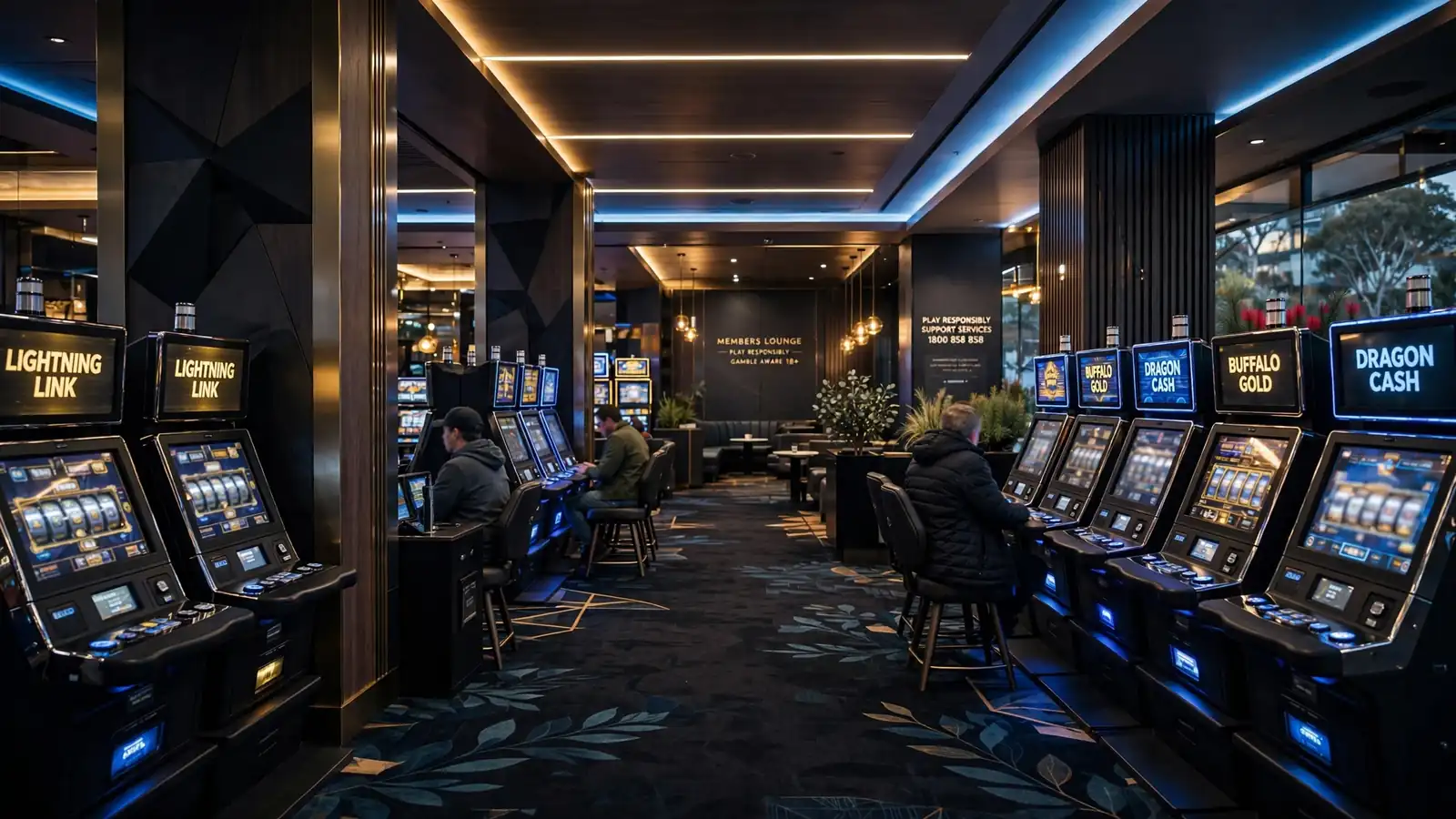
In Australia, “pokies” is a familiar term for electronic gaming machines. A “pokies parlour” therefore suggests a physical place where those machines are available. In a casino, the phrase may describe a machine-focused area within the larger venue, rather than a separate casino with its own identity. The exact layout and terminology can differ from one property to another.
That distinction matters because a casino is a whole venue, while a parlour is a narrower description of a setting or activity. A casino may encompass gaming areas and other facilities; calling one part a parlour directs attention to the machines. It does not, by itself, establish that the area is a separately licensed property or that every casino uses the same name for it.
The wording can also be used loosely. Someone might say “pokie parlour” when they mean a room of machines, a casino’s machine area, or simply a casino experience centred on pokies. Those meanings overlap, but they are not identical. The phrase describes what a person expects to find more readily than it identifies a formal venue category.
Top operators
If you’re looking for a pokies parlour casino in Australia in 2026, licensing and stated deposit details can help you assess the options. Use these short verdicts as a starting point for your own checks.
-
Thor Casino
- License
- Curacao – Antillephone N.V. (Versus Odds B.V.)
- Min. deposit
- EUR 20
Thor Casino is listed under a Curacao licence held by Antillephone N.V. (Versus Odds B.V.). Its stated minimum deposit is EUR 20.
-
Lucky Dreams
- License
- Curacao
- Min. deposit
- A$20 (POLi)
Lucky Dreams has a Curacao licence and lists a minimum deposit of A$20 when using POLi.
-
DragonSlots Casino
- License
- Curacao Gaming Authority (Jumpman Gaming Ltd)
DragonSlots Casino is listed under the Curacao Gaming Authority, with Jumpman Gaming Ltd named as the operator.
-
Neospin
- License
- Curacao Gaming Control Board OGL/2023/176/0095 (Hollycorn N.V.)
Neospin is listed under Curacao Gaming Control Board licence OGL/2023/176/0095, held by Hollycorn N.V.
-
Playfina Casino
- License
- Curacao eGaming (Hollycorn N.V., since 2017)
- Min. deposit
- A$20-30 (depends on the offer)
Playfina Casino has been associated with Curacao eGaming and Hollycorn N.V. since 2017. Its stated minimum deposit is A$20–30, depending on the offer.
-
7Bit Casino
- License
- Curacao, operated by Dama N.V.
7Bit Casino is listed as operating under a Curacao licence, with Dama N.V. named as its operator.
-
House of Pokies
- License
- international iGaming licence – jurisdiction not named in the source
- Payout speed
- PayID 1-24 hours
- Min. deposit
- A$30 (PayID from A$10)
House of Pokies lists an international iGaming licence, though the jurisdiction is not named. It states PayID payouts of 1–24 hours and a minimum deposit of A$30, or A$10 when using PayID.
-
JustCasino
- License
- Curacao Gaming Control Board
JustCasino is listed under the Curacao Gaming Control Board.
-
SpinsUp
- License
- Curacao Gaming Control Board OGL/2023/174/0082 (Dama N.V.)
SpinsUp is listed under Curacao Gaming Control Board licence OGL/2023/174/0082, with Dama N.V. named as the operator.
-
Golden Pokies
- License
- Curacao
Golden Pokies is listed with a Curacao licence.
A physical place, not just a label
When the subject is a physical parlour, the practical reference is to an in-person gaming area. The word “parlour” gives the impression of a distinct room or zone, but the phrase alone cannot tell you how a particular casino is arranged. It should not be treated as a standard floor plan or a guarantee that the machines occupy a separate room.
“Parlour casino” can likewise blur two ideas: the casino as a complete venue and the machine-focused space within it. If you are trying to understand a particular property, its own venue description is more precise than the general phrase. The label may be useful in ordinary conversation, but it does not settle questions about the property’s scope or facilities.
Online, the same words may appear as a description of a physical venue, as a broad topic, or as wording attached to internet gambling. That use of the phrase does not turn a website into a physical parlour, nor does it establish what kind of service a website provides. The setting has to be clear from the context: a venue description refers to a place; a web page is still a web page.
This is a small distinction with a practical effect. If you mean a physical casino area, the relevant subject is the venue and its facilities. If you encounter the same phrase online, the wording alone tells you little about the service behind it. A familiar term is not a venue check.
Scale without treating every venue as identical
Australia has a substantial land-based casino sector, but a single label does not describe every property equally well. A specialist review has reported more than 20 full-scale casinos across Australia’s eight states. That figure should be read as a reported snapshot, not as a permanent count: venues and market descriptions can change, and the phrase “full-scale casino” itself matters. It does not mean that every location with gambling is a casino, or that every casino has the same mix of facilities.

A separate national measure records 3,308 gaming machines endorsed on venue licences and installed in Australian casinos. This gives a sense of the scale of machine provision across casino venues, without making “parlour” a uniform category. The total is a sector-wide count, not a description of what you will find in any one room. A national figure cannot substitute for a property’s own details.
The distinction between a broad market measure and a local description is worth keeping. The number of casinos tells you about the sector’s reach; the machine count indicates the scale of one part of casino gaming. Neither number tells you how a particular casino labels its machine area, how it is arranged, or what other facilities sit alongside it. Those are venue-specific matters.
So, in Australian usage, a pokies parlour is best understood as a plain-language reference to a physical, machine-focused casino area—not necessarily a standalone venue or a formal category shared by every property. The wider casino sector is sizeable, but its venues should not be assumed to be interchangeable. Useful distinction.
Where Australian Casinos Are—and What the Location Data Shows
Casino locations are spread across Australia, but a venue count depends on what is being counted: a casino, a broader gambling facility or a city with gambling activity. Those categories are not interchangeable. A specialist location roundup, for instance, records gambling activity in 147 Australian cities. Treat that as a dated snapshot of its chosen category, not as a permanent count of casino buildings.
The same distinction matters in Sydney. A specialist gambling-location listing identifies Sydney, in New South Wales, as the country’s largest gambling city and counts 11 gambling facilities there. That figure describes facilities in the listing’s scope; it does not mean Sydney has 11 casinos. For a visitor comparing destinations, the useful first question is whether a count refers to casino venues specifically or to a wider set of gambling locations.

Northern Territory locations
A specialist casino-location directory reports three casinos across three Northern Territory cities. Its city-level breakdown names Alice Springs as the territory’s city with the most casinos, counting one there. The wording is easy to misread: “most” is a comparison between cities in that directory, not a suggestion that Alice Springs has several casinos.
One named venue is Lasseters Casino, at 93 Barrett Drive in Alice Springs, NT 0870. The address places it within the town rather than leaving the location at territory level. When checking a destination, a street address is more practical than a state or territory label: it helps distinguish the actual venue from a broad regional entry.
Other listed locations show how varied the geographic descriptions can be. Jupiters Gold Coast Casino & Hotel sits on Broadbeach Island, on the Gold Coast. Country Club Casino is associated with Country Club Avenue in Prospect, within Meander Valley. These descriptions use different reference points—an island, a suburb and a local government area—so comparing them requires attention to the level of detail, not just the venue name.
Read counts alongside place names
A map or directory can orient you, but its labels should be read precisely. “City with gambling” may include facilities beyond casinos, while a casino count is narrower. A venue’s locality may also be described by a suburb or district rather than by the nearest major city. That is why a list can be useful for finding a region yet still require a separate check of the specific property’s address.
For a physical casino trip, start with the venue name and locality, then confirm the address against the property’s own current information before travelling. That simple comparison catches a common mismatch: a city-level listing can establish the general area without identifying the entrance or precise site. Geography first; labels second.
Casino Reviews: Check the Licence and the Venue Details
A useful review of a pokies parlour should help you separate checkable details from opinion. A star score can summarise someone’s view, but it cannot tell you which authority is responsible for a casino’s licence or whether the review is describing the venue you intend to assess.
Do
- Identify the physical venue and its location
- Check which state or territory jurisdiction issued the licence
- Distinguish factual statements from personal preferences
- Verify the venue's status through the responsible jurisdiction
Don't
- Rely on a vague assurance of being "licensed"
- Treat a star score as proof of legal authority
- Assume a high ranking is based on transparent criteria
- Carry claims over to another property if names change without explanation
In Australia, casino licensing sits with state and territory jurisdictions. Each casino operates under a licence issued by its local jurisdiction. That makes the jurisdiction the first point to establish when reading a review: identify the physical venue, identify where it is located, then check which jurisdiction is responsible for its licence. A review that discusses a casino without making that connection leaves out a central part of the picture.
A practical review checklist
| Review detail | What to check |
|---|---|
| Venue identity | Does the review clearly name the casino and describe the same physical property throughout? |
| Location | Does the stated location match the venue being discussed? |
| Licensing jurisdiction | Does the review identify the state or territory responsible for the casino’s licence? |
| Evidence and opinion | Can you distinguish factual statements from the reviewer’s preferences and impressions? |
| Scope | Is the assessment about the physical casino, or does it drift into claims about something else? |
The jurisdiction matters because “licensed” is not a complete description by itself. A review should make clear which local jurisdiction issued the licence, rather than relying on a vague assurance or using the word as a badge of quality. If that detail is absent, treat the review as incomplete and verify the venue’s status through information provided by the responsible jurisdiction.
Venue identity deserves the same care. Names can be shortened, properties can have hotel or entertainment components, and a review may refer to a venue in general terms. Check that its wording consistently points to the same casino and location. If the review changes names without explaining the connection, you cannot confidently carry its claims over to another property.
Next, separate observable details from evaluations. Statements about a reviewer’s preferred atmosphere or service are personal judgements, not proof of licensing or a universal measure of quality. That does not make them useless; it means they answer a different question. Your own priorities determine which impressions matter. A review that suits you best depends on the criterion you care about, not on the highest score alone.
Pay attention to how confidently claims are presented. Strong adjectives do not strengthen evidence, and a neat rating table does not explain how scores were reached. Look for a clear basis for each assessment and whether the review tells you what it actually examined. If it offers a ranking without explaining its criteria, the ranking may be easy to scan but hard to use.
A short, transparent review can be more useful than a long one that blurs opinion and fact. For a physical casino, the key checks are the venue’s identity, its location, and the local jurisdiction responsible for its licence. Then decide whether the reviewer’s stated criteria match your own. No score can make that decision for you. A tidy badge is not a licence record.
Opening Hours, Entry Age and Access at Physical Casinos
For major Australian casinos, the basic access picture is straightforward: they operate around the clock, and the minimum age for casino entry is 18 nationwide. That gives you a reliable starting point when planning a visit, but it does not make every part of a venue available to every visitor at all times. A casino may contain distinct areas, and access conditions can depend on the space you intend to enter.

A VIP parlour is a particular area or access category, not a reason to assume that ordinary entry requirements disappear. The term alone does not establish who may enter, what identification is accepted, or whether separate arrangements apply. Check the venue’s own current entry information if you are planning to visit a restricted area; do not treat a label as proof of access.
For entry to a major Australian casino, bring valid photo identification. The age threshold is the same across the country, but you still need to be able to demonstrate that you meet it. If you are travelling with someone under 18, do not assume that the casino floor or a parlour is accessible to them; the 18-year minimum applies to casino entry.
The practical comparison is therefore simple: operating hours tell you when a major casino is open, while age and ID determine whether you can enter. Twenty-four-hour operation does not mean that every room has identical access conditions, and a VIP designation does not replace the venue’s entry rules. Check the specific venue details before setting out, especially when your plans depend on access to a particular area.
Open all day. Entry still has rules.
Parlour Pokies and the Limits of the Available Numbers
The national count gives one useful measure of the scale of casino gaming machines: 3,308 machines are endorsed on venue licences and installed in casinos across Australia. It is a combined figure, not a description of what you would find in any one parlour.

That distinction matters. A national total cannot tell you how machines are distributed between venues, whether a particular casino has a dedicated parlour, or what its current floor layout looks like. Nor does the figure establish that every casino offers the same machine selection or arrangement. The licence and installation count describes machines across the sector; it is not a venue-by-venue inventory.
For a specific physical casino, treat “parlour” as a description of an area or setup that needs to be confirmed with that venue. The national count alone cannot verify whether such a space exists, how it is organised, or which machines are available there. Those details require current information from the casino itself.
The count is also narrower than a full picture of a casino. It concerns gaming machines recorded as installed and endorsed on venue licences. It does not, by itself, describe other parts of the venue or tell you how busy a machine area is.
So the figure is useful for scale, but not for comparing individual parlours. A larger national total does not mean a particular venue has more machines, and a sector-wide count should not be read as a promise about a visitor’s experience. Specifics matter.
Sign-Up and No-Deposit Bonus Searches: What You Can Verify
A sign-up bonus or a no-deposit bonus may sound like a simple offer attached to a casino account. For someone looking for a physical pokies parlour, however, those words point in a different direction: they describe a claimed online promotion, not an entry benefit that can be assumed to exist at a venue. The wording does not establish that an offer is genuine, that it applies to Australian residents, or that the service behind it may lawfully provide online casino games in Australia.
That distinction matters before you compare any advertised terms. In Australia, the Interactive Gambling Act 2001 makes it illegal for operators to provide real-money online casino games to people in the country. Casino-style services such as online slots, poker and table games fall within the prohibited category when offered to customers in Australia. A bonus label cannot change the legal status of the underlying service.
What the bonus wording does—and does not—tell you
“Sign-up” suggests a benefit tied to creating an account, while “no deposit” suggests a claim that an account holder need not first deposit funds to receive it. Those descriptions are marketing language, not evidence. They do not, by themselves, establish that an offer exists, who could qualify, what conditions apply, or whether the operator is permitted to offer the service to Australians.
The same caution applies when “pokies parlour” appears alongside “bonus.” The phrase can blend a physical venue idea with online casino language, but that combination does not turn an online promotion into a feature of a local parlour. Nor does it establish that a particular website represents a licensed Australian casino. A result can use familiar local wording and still leave the key questions unanswered.
| What you see | What it establishes |
|---|---|
| A headline promising a sign-up bonus | That the page makes a promotional claim |
| A no-deposit label | That the page uses those words, not that the offer is valid for you |
| A page that loads in Australia | That it is accessible at that moment |
| An alternate web address | That another address is being used, not that the operator is locally licensed |
The distinction is straightforward: a claim about a promotion is not proof of the operator’s legal authority. An accessible website, account traffic, or an alternate domain does not establish that a service is an Australian-licensed online casino. In this market, accessibility is a poor substitute for legal status.
Why a bonus cannot make the service lawful
A promotion is attached to a service. If the service is an online casino providing prohibited games to people in Australia, adding a welcome offer does not make that service permissible. The legal question concerns what the operator provides and to whom, not whether the first account activity is described as free, introductory or deposit-free.
This is also why a bonus page should not be treated as a reliable route to an Australian casino offer. There is no Australian licence for operators to provide real-money online casino games to people physically located in the country under the Interactive Gambling Act. The terms “licensed,” “registered,” or “verified” on a site are not enough on their own to alter that boundary. A label is a claim; it is not a grant of authority from an Australian jurisdiction.
For a physical casino, the relevant framework is different: Australian casino properties operate under licences issued by their respective state or territory. That fact should not be confused with permission for an online casino to offer real-money games to Australian customers. A venue’s physical presence, or its use of a local-sounding name, does not confer online authority on a separate website.
A practical way to read a promotion page
When you encounter a sign-up or no-deposit claim, separate three questions rather than letting the headline answer all of them:
- What is being claimed? Identify whether the page describes a bonus, account benefit, or other promotional language. Do not infer more than the words actually say.
- What service sits behind it? Determine whether the page is promoting online casino games for Australian customers. If it is, the relevant issue is the prohibition on operators providing those services in Australia.
- What proves the operator’s status? A working page, a polished presentation, or a changed address is not evidence of Australian licensing. The appearance of a site cannot settle the legal question.
This is a test of the claim, not a method for finding an offer. It does not point you toward a website or imply that a qualifying Australian online casino bonus exists. A promotion may look specific while leaving the decisive issue untouched: whether the operator can lawfully provide the underlying online casino service to people in Australia.
Keep account language separate from venue access
The phrase “no deposit” can also mislead by making an online account sound comparable to walking into a physical gaming venue. They are not the same kind of access. A venue has a physical location and operates under a local jurisdiction’s casino licence; an online account is part of a service delivered through a website. The promotional wording does not bridge that difference.
Likewise, a bonus claim should not be read as proof that the provider is a physical casino, or that an online brand is an extension of one. Names and imagery can create an impression of connection, but that impression is not evidence of licensing or legal permission. If the key claim is simply that an account can be opened or a page can be reached, it answers only a question of access—not whether the service is lawful in Australia.
The most reliable reading is therefore restrained. Treat a sign-up or no-deposit bonus as an unverified promotional claim unless its existence and terms are established; do not treat it as evidence that an Australian online casino offer is legitimate. More importantly, no stated benefit changes the rule that operators may not provide real-money online casino games to customers in Australia. A bonus headline cannot do that work.
Free Chips and Spins: Treat the Search Terms as Claims to Check
Words such as “free chips” and “free spins” can make a page sound like it is offering something immediately usable. They do not, by themselves, show that an offer exists, who is making it, or whether it applies to people in Australia. Treat the wording as a claim to assess, not as a promise or recommendation.
Start with the source of the statement. Is it on a site presenting itself as the operator, or on a page describing another service? An advert, review, social post or copied promotional line may repeat the same phrase without confirming the terms. A polished page is not proof either. What matters is whether the statement can be tied to a clearly identified service and whether the details are consistent.
Then separate the two kinds of wording. A claim about spins refers to use of a particular game feature; a claim about chips may refer to a balance or credit described by the site. Those labels are not standard evidence of value or access. Without clear terms, you cannot tell what the words mean in practice, whether conditions apply, or whether the claim is current. Do not infer an amount, a cash value or a withdrawal right from the label.
A useful comparison is simple: claim, source, terms, and status. If one of those columns is blank, the promotional wording has not answered the practical question. A countdown, a large button or a repeated banner does not fill the gap. Nor does a page saying “free” establish that no conditions exist. Read the wording as an assertion that needs substantiation.
There is another complication in Australia: a page’s availability can change. ACMA enforcement records describe website-blocking action against illegal gambling services, including alternate domains associated with Fair Go. Blocking can affect which domain addresses resolve through Australian internet service providers, while different addresses may appear later. As a result, a page opening today—or a new address displaying similar wording—does not establish that the service is legitimate or authorised for Australians.

That distinction matters when promotional claims travel between domains. A familiar name, matching graphics or the same “free” language may suggest continuity, but appearance is not proof of the operator’s status. Conversely, a domain that fails to load is not a reliable way to determine what a previous page promised. The address and the claim are separate pieces of information.
Keep a record of the exact wording and the page where you saw it if you need to assess a disputed claim. Note whether the page identifies who is responsible for it and whether its terms explain the conditions. Avoid treating a promotional phrase copied elsewhere as confirmation. Repetition is not verification.
The practical conclusion is narrow: free-chip and free-spin language tells you what a page wants you to believe, not whether the offer is real, applicable or valid in Australia. Check the claim’s source and supporting terms; do not use the page’s accessibility, changing address or promotional design as a substitute. A banner is still a claim.
Playing Online: The Australian Regulatory Boundary
Online casino-style games sit on the prohibited side of Australia’s federal gambling rules. Under the Interactive Gambling Act 2001, it is illegal for operators to provide real-money casino games to people who are physically in Australia. That includes online slots, poker and table games such as blackjack and roulette. The boundary concerns the service offered to customers in Australia, not the wording used to describe it.
The federal regulator is the Australian Communications and Media Authority (ACMA). It oversees compliance with the country’s interactive gambling laws and enforces the Act. This is distinct from the state and territory arrangements that govern physical casinos: an online casino-style service does not become lawful for Australian customers simply because it has a presence elsewhere or appears to operate under a foreign framework.
What ACMA can do
ACMA may ask Australian internet service providers to block websites that provide prohibited interactive gambling services or advertise them to people in Australia. Blocking is an enforcement measure aimed at limiting access to those sites through Australian providers. It is not a declaration that every other site still reachable is authorised, nor does a domain’s disappearance establish the full status of the service behind it.
The regulator’s enforcement record shows the scale of that activity. Since November 2019, ACMA has blocked more than 1,455 illegal gambling and affiliate websites after taking enforcement action. Blocking can affect which domains resolve through Australian internet providers, while alternate addresses may emerge over time. A changing web address is an access detail, not evidence of Australian approval.
ACMA has also reported that more than 210 illegal services withdrew from the Australian market after enforcement began in 2017. A separate reported figure puts withdrawals since that year at more than 190. The clear point is that withdrawal and blocking have both formed part of the federal response.
Read the boundary, not the interface
A site may load, accept account traffic or display casino-style games. None of those interface details overrides the legal restriction on operators providing real-money online casino services to people in Australia. Likewise, an overseas licence or an alternate domain is not an Australian licence. Availability is not authorisation.
This distinction matters when you encounter language about online play, including claims that a service is free to use. The regulatory question depends on what the service provides and how it is offered; promotional wording by itself does not settle that question. ACMA’s blocking powers also extend to websites advertising prohibited interactive gambling services in Australia, not only sites that host the games.
The practical dividing line is therefore straightforward: physical casinos operate under state or territory licensing, while real-money online casino games offered to customers in Australia are prohibited under federal law. ACMA monitors and enforces that rule, including through requests to providers to block relevant websites. A page that remains visible is no substitute for checking the legal framework. Availability is a poor test.

“Real Money” Search Results Do Not Establish Australian Legitimacy
A page that describes an online casino as offering real-money play is making a claim about its product, not proving that it is authorised to provide that service to people in Australia. The same applies to polished branding, account pages, payment information or language aimed at Australian visitors. These details may tell you what a site says it offers; they do not establish its legal status here.
The distinction matters because online casino-style games for real money are prohibited for operators to provide to customers in Australia. A foreign licence, where claimed, is not an Australian licence. Nor does a site’s presence in search results turn its service into a lawful Australian offering. Wording is not authorisation.
Access is a separate question from legitimacy. A website may load, accept account traffic or appear at an alternate domain, but none of those conditions establishes that it is an Australian-licensed online casino. Blocking can affect which addresses resolve through Australian internet service providers, and alternate addresses may appear over time. That change in availability is a technical circumstance, not proof of approval.
For a careful comparison, separate each claim into two columns: what the site says about itself, and what can be established about its status under Australian law. If the only support is the site’s own wording or its current accessibility, the second column remains unanswered. Do not treat “real money” as a quality mark, a regulatory category that grants permission, or evidence that the service is legitimate for Australian customers.
A physical casino and an online service are also different regulatory contexts. The word “casino” in a page title or brand does not make the online product equivalent to a licensed Australian venue. Keep the criterion clear: real-money wording describes the claim; it does not verify Australian legitimacy.